12.3.11

Want to grow your business? It's time to go social

¿Quieres hacer crecer tu negocio? Es hora de volverse social

---


---

Just a few months, the networking for growing businesses meant losing the little time they had at lunch with business people from various fields who, at that time, I was completely beaten.

Well, that is no longer true, since the evolution of social media, led by Facebook and Twitter, has transformed the way people touch each other and becomes more and more strength in the business community, where networking is now essential to ensure growth.

A recent report in the UK, suggests that companies have adopted the social media are far more likely to increase their turnover, as those not using them. Consumers are faced with companies so that communication becomes much more regular and intimate, which builds trust and credibility.

This situation is so obvious that the support that aims to provide the Government seems to have no effect, or at least generates very little interest. Only 21.7% of respondents think the government is taking actions needed to support the growth of companies when they first started the business.

About 40% of respondents said they use Internet for research and the real thing is that there are many sites that claim to offer employers, managers and owners of growing businesses the support they need.

An example is LinkedIn, the professional network which enables small and medium enterprises have opened so-called "OppenCoffee" forums that meet to discuss problems or request information and advice. They are making virtual networking, but often travel to the real world.

If this need to be present in the media, we added the impressive growth of smartphones, we obtain the result that firms seek to mark their presence in social networks, mainly Facebook and Twitter, the two in which each day we find new brands making their foray.

In addition, social networks and geolocation Forsquare are beginning to be exploited by retailers and restaurants. While initially let us know where our friends, these small firms employ to encourage people to visit their premises.

For now, the biggest problem facing many companies is to understand the social networking revolution. Those belonging to the technology industry have it easier, but other firms must rely on monitoring and analyzing social networks to make measurements and detailed reports on what is being said about them online.

Likewise, the use of social media among companies, although in an early stage, are designed to adapt. As stated a Gartner report, "social businesses become" as they have the need to explore and then exploit the opportunities offered by new media.

Until now, professional service and best-known networking is LinkedIn, but day after day there are many new ones. For many managers and owners, the main attraction that we offer all of them is the ease with which they can build networks coming directly to the point, without having to spend time and money and power interact in the schedule that is most convenient, especially night, greatly facilitating networking.

The key for them is to maximize the network, obtaining information, tips on business or simply company, as many managers and owners found themselves in the position they occupy and thus, find further support. Yes must decide which of them participate as it needs to profit from it or otherwise, believe that it was better to meet for lunch, but trying to escape from these commitments.

---

Hace muy pocos meses, el networking para las empresas en crecimiento significaba perder el poco tiempo que tenían en almuerzos con personas de negocios de diversos campos que, en ese momento, les daba completamente igual.

Pues eso ya no es así, pues la evolución de los medios de comunicación social liderados por Facebook y Twitter, ha transformado la forma en que las personas tienen contacto entre sí y cobra cada día más fuerza en la comunidad empresarial, donde el networking ahora es fundamental para asegurar el crecimiento.

Un reciente informe realizado en UK, sugiere que las empresas que han adoptado los medios de comunicación social tienen muchas más posibilidades de acrecentar su volumen de negocios, que aquellas que no las emplean. Los consumidores se enfrentan a las empresas de modo que la comunicación se hace mucho más regular e íntima, lo que genera confianza y credibilidad.

Es tan evidente esta situación que el apoyo que intenta ofrecer el Gobierno parece no tener efecto alguno, o al menos genera muy poco interés. Sólo un 21,7% de los encuestados piensa que el Gobierno está realizando acciones necesarias para apoyar el crecimiento de las empresas cuando recién inician el negocio.

Alrededor de un 40% de los encuestados expresó que usa Internet para la investigación y algo real es que existen muchos sitios que dicen ofrecer a los empresarios, gerentes y propietarios de empresas en crecimiento el apoyo que necesitan.

Un ejemplo es LinkedIn, la red social profesional en la que las pequeñas y medianas empresas han abierto los denominados “OppenCoffee”, foros en los que se reúnen para comentar problemas o solicitar información y pedir consejos. Están haciendo networking virtual, aunque muchas veces se trasladan al mundo real.

Si a esta necesidad de estar presentes en los medios de comunicación, le añadimos el impresionante crecimiento de los Smartphones, obtenemos como resultado que las empresas procurarán marcar su presencia en las redes sociales, principalmente Facebook y Twitter, las dos en las que cada día encontramos nuevas marcas haciendo su incursión.

Además, redes sociales de geolocalización como Forsquare están comenzando a ser explotadas por los minoristas y restaurantes. Si bien en un inicio nos permiten saber dónde están nuestros amigos, estas pequeñas empresas las emplean con el fin de animar a las personas a visitar sus locales.

De momento, el mayor problema que enfrentan muchas empresas es comprender la revolución de las redes sociales. Aquellas que pertenezcan a la rama tecnológica lo tienen más fácil, pero las demás deben apoyarse en empresas de vigilancia y análisis de redes sociales con el fin de realizar mediciones e informes detallados sobre lo que se está diciendo de ellos en la red.

Igualmente, el uso de los medios de comunicación social entre las empresas, si bien se encuentra en una fase inicial, están destinadas a adaptarse. Como expresa un informe de Gartner, “los negocios se vuelven sociales” pues tienen la necesidad de explorar para luego explotar las oportunidades que brindan los nuevos medios.

Hasta ahora, el servicio profesional y de networking más conocido es LinkedIn, aunque día tras día surgen muchos nuevos. Para muchos gerentes y propietarios, la atracción principal que nos ofrecen todas ellas es la facilidad con la que pueden construir redes llegando directamente al punto, sin necesidad de invertir tiempo y dinero, además de poder interactuar en el horario que les sea más conveniente, principalmente la noche, facilitando mucho el networking.

La clave para ellos es aprovechar al máximo las redes, obteniendo información, pistas de negocios o simplemente compañía, pues muchos gerentes y propietarios se encuentran solos en el cargo que ocupan y de este modo, encuentran mayor respaldo. Sí deben decidir en cuál de ellas participar pues necesita obtener un beneficio de ello o de lo contrario, creerá que era mejor reunirse para almorzar, aunque intentaban escapar de estos compromisos.

---

http://www.puromarketing.com/42/9253/quieres-hacer-crecer-negocio-hora-volverse-social.html

11.3.11

Tools to measure results in Social Media

Herramientas para medir resultados en Social Media

---

Have you heard that Social Networking actions can not be measured? If so forget it because there are hundreds metrics that help us know if our Social Media strategy is working or if instead we have to change something, and today we will see some of them.

Feedback from users on Facebook
View the number of users who click on "Like" in the publications of our Facebook wall is fine, but we must go further and therefore we have to measure how many and how often do fans click on "I Like" and also leave a comment in the update of the wall.


The higher the visibility data and our updates will have more growth potential. To verify these data it is best that you check frequently Facebook statistics.

The Twitter Klout
Do you measure the number of followers on your Twitter account? Like on Facebook, is a good step, but if we get more reliable data we have to search more accurate metrics, and one of them is the Klout.


The Klout is an indicator of the level of influence found a Twitter account, which draws on parameters such as fans, retweets ... and a set of values ​​that are constantly updated to make every day a more reliable data.
Search volume of your brand.

Another very important is to gauge how many times people look for your brand name into a search engine, because the Social Networks provide visibility to the brand and this is reflected in the searches that people do.

To view Google insigths can use that will give you information on the search volume of your brand or your products.

Number of issues
Measure the number of times your brand is referenced in social media is a good indicator to know how things are working your actions in Social Media, and for that you can measure for 30 days the number of mentions in various social media using the free tool Social Mention. Then do the same with your competitors and analyzes how many times they mention them in the same period of time.

Once the entries recorded collects (yours and your competitors) and divide your entries by the total entries made and this formula will give the so-called "Share of Voice", which is the percentage of your social media mentions total function of your sector.

Value of posts
In any strategy in social networks is a "must" have a corporate blog, so we must measure our blog if you really like and people find value in it.


For this we can measure the degree of loyalty of the readers using the application PostRank Analytics, which will give us interesting and useful statistics about the degree of acceptance of our blog.

With these five metrics can learn more about the degree of success of your presence in social networks.

---

¿Has oido decir que las acciones en Redes Sociales no se pueden medir? Si es así olvídalo porque hay cientos métricas que nos ayudarán a saber si nuestra estrategia en Social Media está funcionando o si por el contrario tenemos que cambiar algo, y hoy vamos a ver algunas de ellas.

Feedback de los usuarios en Facebook
Ver el número de usuarios que hacen click en “Me gusta” en las publicaciones de nuestro muro de Facebook está bien, pero debemos ir más allá y por ello tenemos que medir cuántos y con qué frecuencia los fans hacen click en “Me gusta” y además dejan un comentario en la actualización del muro.


Cuanto mayor sea este dato mayor visibilidad tendrán nuestras actualizaciones y mayor potencial de crecimiento. Para comprobar estos datos lo mejor es que revises frecuentemente las estadísticas de Facebook.

El Klout de Twitter
¿Mides el nº de seguidores en tu cuenta de Twitter? Al igual que sucede en Facebook, es una buena medida, pero si queremos obtener datos más fiables tenemos que buscar métricas más precisas, y una de ellas es el Klout.


El Klout es un indicador del nivel de influencia online de una cuenta en Twitter, que toma como referencia parámetros como seguidores, retweets… y una serie de valores que están en constante actualización para conseguir día a día un dato más fiable.
Volumen de búsqueda de tu marca.

Otro indicador muy imporante es las veces que la gente busca el nombre de tu marca en un buscador, puesto que las Redes Sociales dan notoriedad a la marca y esto se refleja en las búsquedas que hace la gente.

Para verlo puedes usar Google Insigths que te dará datos sobre el volumen de búsqueda de tu marca o tus productos.

Número de menciones
Medir el número de veces que tu marca es referenciada en medios sociales es un buen indicador para saber qué tal están funcionando tus acciones en Social Media, y para ello puedes medir durante 30 días el número de menciones en distintos medios sociales usando la herramienta gratuita Social Mention. A continuación haz lo mismo con tus competidores y analiza las veces que les mencionan a ellos en el mismo período de tiempo.

Una vez contabilizadas las menciones suma todas (las tuyas y las de tus competidores) y divide tus menciones por el total de menciones hechas y está fórmula te dará el llamado “Share of Voice”, que será el porcentaje de tus menciones en medios sociales en función del total de tu sector.

Valor de los posts
En cualquier estrategia en Redes Sociales es “imprescindible” contar con un blog corporativo, por lo que deberemos medir si realmente nuestro blog gusta y la gente encuentra un valor en él.


Para ello podemos medir el grado de fidelización de los lectores usando la aplicación PostRank Analytics, que nos dará interesantes y útiles estadísticas sobre el grado de aceptación de nuestro blog.

Con estás cinco métricas podrás saber más sobre el grado de éxito de tu presencia en Redes Sociales.

---

http://www.socialblabla.com/herramientas-para-medir-resultados-en-social-media.html

10.3.11

The "social television", the new trend among young people

La 'televisión social', la nueva tendencia entre los jóvenes

---


---

A virtual museum, a commemorative bottle collector and a meeting will be other actions that the Company will start to celebrate its 125 anniversary

The Company has introduced its new global advertising campaign, by McCann Erickson Spain, which will air from next March 14

British youth are leading to a new TV because of the tendency of social networks, which could be powerful for the world of broadcasting and advertising, says a report from the Agency Clarity, an expert in digital marketing.

According to a survey of 1300 mobile Internet users in the UK under 25 years, we see that the vast majority use a mobile device to talk to their friends about the program you are watching on TV.

The trend of social television exposure for the study, could change the landscape for broadcasters and advertisers to achieve attract younger. Eight out of ten respondents who had used Twitter, Facebook or other mobile application for comment actively in programs and chat with friends while watching.

"Until 12 months ago, television was struggling to reach the youth market," said Reggie James, founder of Clarity. "The social television has changed completely and now focuses on communications that have about the programs as they happen."

The social importance of television is not lost on television networks on the contrary, they have found a new market where advertisers must have a different tone.

A joint study by Nielsen and Yahoo United States last year, found that the trend was well established in that country, where over 86% of mobile Internet users communicate with their peers in real time for digital broadcasts.

Last month, HBO in the United States showed the movie "Private Parts" while also providing live, received very positive reviews of what could have been predicted in a movie 14 years old.

Now, this trend is also seen in the UK and users are ready to join the conversation. "It is now that companies should tap the huge market that offers social television."

One of the main findings of the study is that social popularity of television is that young people can make a comment to all your friends in real time in each of your favorite programs. "They are in different cities, but it's like to be with them to watch TV," said a 20-year-olds in the survey.

The British study found that the most common way to communicate is Twitter, with 72%, followed by Facebook with 56% and other mobile applications, with 34%. 62% of users of social TV, combines all three.

34% of respondents said that the trend is fun, 32% made more interesting television and 42% said the community that forms behind them.

---

Un museo virtual, una botella conmemorativa y un encuentro entre coleccionistas serán otras de las acciones que la Compañía pondrá en marcha para celebrar su 125 aniversario

La Compañía ha presentado su nueva campaña de publicidad mundial, realizada por McCann Erickson España y que estará en el aire a partir del próximo 14 de marzo

Los jóvenes británicos están llevando hacia una nueva televisión debido a la tendencia de las redes sociales, lo que podría tener gran alcance para el mundo de la radiodifusión y la publicidad, destacó un informe de la Agencia Clarity, experta en marketing digital.

Según una encuesta de 1300 usuarios de Internet móvil en UK debajo de los 25 años, vemos que la gran mayoría utiliza un dispositivo móvil para hablar con sus amigos sobre el programa que están viendo en la TV.

La tendencia de televisión social expuesta por el estudio, podría cambiar el panorama para los radiodifusores y anunciantes para lograr atraer a los más jóvenes. Ocho de cada diez respondieron que habían utilizado Twitter, Facebook u otra aplicación móvil para comentar activamente en programas y chatear con sus amigos mientras miran.

“Hasta hace 12 meses, la televisión estaba luchando para llegar al mercado de los jóvenes”, expresó Reggie James, fundador de Clarity. “La televisión social ha cambiado por completo y ahora gira en torno a las comunicaciones que tienen en torno a los programas a medida que suceden”.

La importancia social de la televisión no se pierde en las redes de televisión que por el contrario, se han encontrado con un nuevo mercado donde los anunciantes deberán tener otro tono.

Un estudio conjunto de Nielsen y Yahoo Estados Unidos el años pasado, encontró que la tendencia estaba bien establecida en ese país, cuando más del 86% de los usuarios de Internet móvil se comunicaban con sus pares en tiempo real durante las transmisiones digitales.

El mes pasado, el canal HBO en Estados Unidos presentó la película “Private Parts” al mismo tiempo que proporcionaba comentarios en vivo, recibió valoraciones muy positivas de lo que pudo haberse previsto en una película con 14 años de antigüedad.

Ahora, esta tendencia también se percibe en UK y los usuarios ya están listos para unirse a la conversación. “Es ahora que las empresas deben aprovechar el enorme mercado que ofrece la televisión social”.

Uno de los hallazgos más importantes del estudio es que la popularidad de la televisión social se debe a que los jóvenes pueden hacer un comentario a todos sus amigos en tiempo real en cada uno de sus programas favoritos. “Ellos están en ciudades diferentes, pero es como estar junto a ellos para ver la televisión”, comentó un estudiante de 20 años de edad en la encuesta.

El estudio británico descubrió que la forma más común para comunicarse es Twitter, con un 72%, seguido por Facebook con un 56% y otras aplicaciones móviles, con un 34%. Un 62% de los usuarios de televisión social, combina los tres.

Un 34% de los encuestados expresó que la tendencia es divertida; un 32% que hizo la televisión más interesante y el 42% mencionó la comunidad que se forma detrás de ellas.

---

http://www.puromarketing.com/45/9226/television-social-nueva-tendencia-entre-jovenes.html

9.3.11

20 practical applications to use video as a marketing and communication tool

20 aplicaciones prácticas para utilizar el vídeo como herramienta de marketing y comunicación

---


---

In the current marketing campaigns, video is becoming increasingly important, and rightly so because it is an excellent measure of promotion, sales and promotional activities, or at least different and with a touch of innovation and a large multimedia component .

There are a multitude of uses and applications to harness the potential and characteristics of video as a tool for marketing and communication. Here, we show you 20 practical applications of online video that you should consider.

1 - Business Profile: A video explaining the company profile, solutions, marketing, etc.., Is a great introduction.

2 - Personal Profiles: everyone in the company have a story to tell, both professionally and personally. Looking for people who have great personality to deal with a video and let it express.

3 - Tour of the company and its cultural aspect: it shows the inside of your workplace. This will be fun and exciting for users.

4 - A video starring creative staff. This is a great way to display your company and promote it.

5 - Have a virtual spokesperson, but in turn must be real. Do not forget that. A good option is to make a 3D person, but never use, as some marketing agencies, an automated reading device.

6 - Outreach: What causes your agency involved? Includes a video of them showing that social and altruistic side of the business. Demonstrate that all is not the mark of money placed in a better position.

7 - Case Study: make videos about people who are involved in some projects in your company. This is a great added value for potential customers.

8 - Testimonies: Same as above, serve as very good showcase.

9 - Customer Service: have a series of basic questions answered on video helps customers, and shows that the company really is willing to go beyond a simple response. The company will gain confidence.

10 - Training: if you offer solutions to your customers, a series of videos explaining how to use that particular tool will earn more credibility.

11 - Comments: very important to share experiences and improve

12 - Interviews: marketing agencies could be developed quickly, creating videos with influential people in a particular field to be of interest to their customers.

13 - Industry news and comments: marketing success often depends on the ability to act in real time and here is a great solution.

14 - Comments: Many people may help explain what is the product offering, customers, employees, etc. They can help with this.

15 - Presentations: is a conference, an event or a presentation in your office or home. The home video news more enthusiasm among potential customers.

16 - Video on your e-mail marketing: no doubt will get more responses than those obtained so far.

17 - Participation in events: each time the company attending an event, leave a video proof of this is very useful for your image. It's also good to record a video with the experiences of those attending the same.

18 - Acknowledgements: this is another way to win loyalty in customers.

19 - Announcements: upcoming events, future customers and all the data you create can be expressed interest in video and thus have greater impact.

20 - Video blogging: it is an alternative to post writings, although it is recommended to keep the two styles.

---

En las campañas de marketing actuales, el vídeo está cobrando cada día más importancia, y así debe ser pues es una excelente medida de promoción, venta y presentación de actividades, o cuando menos, diferente y con un toque de innovación y un gran componente multimedia.

Existes múltitud de usos y aplicaciones para aprovechar el potencial y las características del video como herramienta de marketing y comunicación. A continuación, te mostramos 20 aplicaciones prácticas del video online que deberías tener en cuenta.

1- Perfil de Empresas: un vídeo que explique el perfil de la empresa, las soluciones, el marketing, etc., es una gran introducción.

2- Perfiles del Personal: todos en la empresa tienen una historia que contar, tanto profesional como personal. Busca aquellas personas que tienen gran personalidad para enfrentarse a un vídeo y deja que se expresen.

3- Tour por la empresa y su aspecto cultural: muestra el interior de tu lugar de trabajo. Esto será divertido y emocionante para los usuarios.

4- Un vídeo con la actuación creativa del personal. Esta es una gran forma de mostrar la empresa y promocionarla.

5- Tener un portavoz virtual: pero a su vez debe ser real. No olvides eso. Una buena opción es hacer una persona en 3D, pero jamás utilices, como hacen algunas agencias de marketing, un aparato de lectura automatizada.

6- Alcance comunitario: ¿en qué causa participa tu agencia? Incluye un vídeo donde muestre ese lado social y altruista de la empresa. Demostrar que no todo va de dinero situará la marca en una mejor posición.

7- Estudio de casos: haz vídeos sobre las personas que participan en algunos proyectos de tu empresa. Esto es un gran valor añadido de cara a potenciales clientes.

8- Testimonios: igual que el anterior, funcionan como muy buen escaparate.

9- Atención al Cliente: tener una serie de preguntas básicas respondidas en vídeo ayuda a los clientes, además de mostrar que la empresa realmente está dispuesta a ir más allá de una simple respuesta. La empresa ganará confianza.

10- Formación: si ofreces solución a tus clientes, una serie de vídeos explicativos de cómo se utiliza determinada herramienta hará que ganes aún más en credibilidad.

11- Sugerencias: muy importantes para compartir experiencias y mejorar

12- Entrevistas: las agencias de marketing pueden elaborarlas de forma rápida, creando vídeos con personas influyentes en determinado campo que resultará de interés para sus clientes.

13- Noticias del sector y comentarios: el éxito del marketing muchas veces depende de la capacidad de actuar en tiempo real y aquí tenemos una gran solución.

14- Comentarios: muchas personas podrían ayudar a explicar de qué va el producto que ofrece, clientes, empleados, etc. Ellos pueden ayudar con este punto.

15- Presentaciones: sea una conferencia, un evento o una ponencia en su oficina o casa. El vídeo informativo casa mayor entusiasmo en los potenciales clientes.

16- Vídeo en su e-mail marketing: sin duda obtendrá mayores respuestas que las que obtiene hasta el momento.

17- Participación en eventos: cada vez que la empresa asista a un evento, dejar un comprobante de ello en vídeo es muy útil para su imagen. También es bueno grabar un vídeo con las experiencias de los asistentes al mismo.

18- Agradecimientos: es otra forma de ganar fidelidad en clientes.

19- Anuncios: próximos eventos, futuros clientes y todos aquellos datos que creas de interés pueden ser expresados en vídeo y así tener mayor repercusión.

20- Vídeo blogging: es una alternativa a los post escritos, aunque se recomienda mantener los dos estilos.

---

http://www.puromarketing.com/30/9212/aplicaciones-practicas-para-utilizar-video-como-herramienta-marketing-comunicacion.html

8.3.11

Social Media cycle for return on investment (ROI)

El ciclo del Social Media para obtener retorno de inversión (ROI)

---

The return on investment is still considered one of the most important issues between the companies, brands and advertisers. However, not all have found the right formula to establish and improve processes and parameters when measuring and quantifying the return on their investment.

Jamie Turner, head of the contents of the "60 second marketer" and co-author of publications such as "How to Make Money with Social Media", in a recent article on Mashable points out the great general interest in social media and especially those aspects related to the methods for calculating the ROI of advertising and marketing campaign through the media.

Turner, examined how companies plan to launch and manage their social media campaigns, reaching the identifying three different stages during this process.


Stage 1: The Beginning.

When the company enters the world of Social Media, focuses on creating and updating profiles on the four major social networks: Facebook, Twitter, LinkedIn and YouTube, and then add some other tools that may be of interest as Flickr, SlideShare , blogs and newsletters, among other social media platforms. But the initiative, all companies tend to appear first in the four social networks listed.

When the company is at this stage, priority delivery on the permanence in time, because the objective is simply to start as soon as possible and move into advanced techniques, so the marketing department, if any, responded by vacuum without a long-term planning.

The mistake that most believe will get results is impressive, when in reality the progress will be, with few exceptions, insignificant. All that remains is to say "I did a campaign on social networks" going to criticize them for not having been successful, but in reality has not reached the second stage.


Stage 2: Management.

When the company reaches this point, we note that a 60% focuses on the four dominant social networks, of which 10% of the attention is focused on creative development, 20% in the monitoring of quantitative indicators such as the traffic or inbound links, and 10% in the scorecard, like the feeling of belonging to the mark by users.

While it still has no long-term planning, has already reached the middle, it will begin to see new developments and many more opportunities. The goal here is to attract potential customers and strive to be recognized and followed by them, increase visits to their websites, increasing sales or by observing that each day they find a "like" back in their Facebook pages.

This site is where the most sophisticated companies that have begun to manage their social presence and care for his reputation, beginning in his creativity and following all the quantitative and qualitative analysis. Few who come to the third stage.


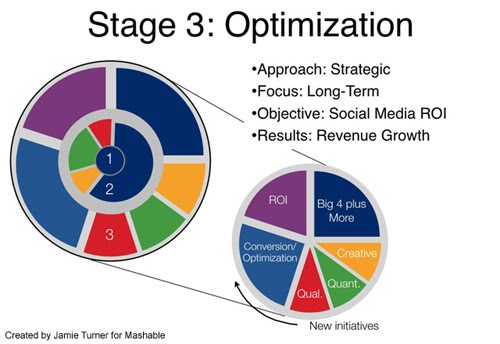
Stage 3: Optimization.

When a company reaches this level, we see that 25% of their attention to account for the four social networks and some other alternative tool, 30% is divided equally between the creative and qualitative indicators, while other 25% focuses on optimizing your marketing campaigns on social networks.

This is where the complications begin to look for is the time to begin to use more sophisticated tools to attract customers, measuring each of its steps, implementing actions as may be to create two different landing pages to see which of them receives more clicks, or use tools such as DART, a global platform that optimizes ad management functions ad, generating even more publicity margins, which also allows us to see the results of various marketing campaigns.

When you finish these campaigns is the time to start measuring the ROI, which is possible, though many think otherwise, and that can be done very simple: take some customers called "lifetime." Namely, if a customer spends € 10 a month in his company and remains faithful for three years, the value to you that customer is 360 €.

Get a new client, as shown by data from several companies, will cost 10% of the value of customer life, ie only 36 €. If the company invests in a year € 36,000 to generate marketing campaigns on social networks, and obtained in the same period of 1000 while new customers will be earning far more than you invested.

The biggest problem encountered is usually the patient, as not all companies are willing to raise long-term strategies and those who expect an ROI at the beginning, it will not seek to do to reverse the way we showed today.


---

El retorno de la inversión sigue siendo considerado uno de los temas más importantes entre las empresas, marcas y anunciantes. Sin embargo, no todos han encontrado las fórmulas adecuadas para establecer y mejorar los procesos y parámetros a la hora de medir, cuantificar el retorno de sus inversiones.

Jamie Turner, responsable de contenidos del "60 second marketer" y co-autor de publicaciones como "How to Make Money with Social Media", en un reciente artículo en Mashable pone de relieve el gran interés general por los medios sociales y sobre todo, aquellos aspectos relacionados con las metodologías para calcular el ROI de las campaña de publicidad y marketing a través de estos medios.

Turner, analizó como las empresas se planifican para la puesta en marcha y gestión de sus campañas en medios sociales, llegando a la determinar tres etapas diferentes durante este proceso.


Etapa 1: El Inicio.

Cuando la empresa ingresa al mundo del Social Media, se centra en la creación y actualización de perfiles en las cuatro redes sociales más importantes: Facebook, Twitter, LinkedIn y Youtube, para luego agregar algunas otras herramientas que puedan ser de interés como Flickr, SlideShare, blogs y boletines electrónicos, entre otras plataformas de comunicación social. Pero por iniciativa, todas las empresas tienden a aparecer primero en las cuatro redes sociales mencionadas.

Cuando la empresa está en esta etapa, prioriza la ejecución sobre la permanencia en el tiempo, pues su objetivo es simplemente comenzar cuanto antes e incursionar en las técnicas de vanguardia, con lo que el departamento de marketing, si lo hubiera, responde lanzándose al vacío sin una planificación a largo plazo.

El error que comete la mayoría es creer que obtendrá resultados impresionantes, cuando en realidad el progreso será, salvo contadas excepciones, insignificante. Lo único que les quedará es el poder decir “hice una campaña en redes sociales”, pasando a criticarlas por no haber obtenido resultados, pero en realidad no se ha llegado a la segunda etapa.


Etapa 2: Gestión.

Cuando la empresa llega a este punto, notamos que un 60% se centra en las cuatro redes sociales dominantes, de los que un 10% de la atención se centra en el desarrollo creativo, un 20% en el seguimiento de indicadores cuantitativos como ser el tráfico o enlaces entrantes, y un 10% en los indicadores cualitativos, como el sentimiento de pertenencia a la marca por parte de los usuarios.

Si bien continúa sin tener una planificación a largo plazo, ya ha llegado al medio, con lo que comenzará ver nuevos avances y muchas más oportunidades. El objetivo aquí es atraer potenciales clientes y procurar ser reconocidos y seguidos por ellos, incrementar las visitas a sus portales, aumentando las ventas u observando que cada día encuentran un “me gusta” nuevo en sus páginas de Facebook.

En este sitio es donde se encuentran la mayoría de las empresas sofisticadas, que ya comenzaron a gestionar su presencia social y a cuidar su reputación, incursionando en la creatividad y siguiendo todos los indicadores cuantitativos y cualitativos para analizarlos. Pocas son las que llegan a la tercera etapa.


Etapa 3: Optimización.

Cuando una empresa llega a este nivel, veremos que un 25% de su atención la acaparan las cuatro redes sociales y alguna otra herramienta alternativa; un 30% se divide en partes iguales entre el desarrollo creativo y los indicadores cuantitativos y cualitativos, en tanto que otro 25% se centra en una optimización de sus campañas de marketing en redes sociales.

Aquí es donde la complejidad comienza a verse pues es el momento en el que se comienzan a emplear herramientas más sofisticas para atraer clientes, midiendo cada uno de sus pasos, implementando acciones como puede ser el crear dos páginas de destino diferentes para ver cuál de ellas recibe más clics, o utilizar herramientas como DART, una plataforma global de publicación de anuncios que optimiza las funciones de gestión de anuncios, generando márgenes publicitarios aún mayores, que además nos permitirá ver los resultados de diversas campañas de marketing.

Cuando se finalizan estas campañas es cuando se debe comenzar a medir el ROI, algo que es posible aunque muchos opinen lo contrario, y eso se puede hacer de forma muy sencilla: tomando algunos clientes denominados “de por vida”. A saber, si un cliente gasta 10€ al mes en su compañía y se mantiene fiel durante tres años, el valor que tiene para usted ese cliente es de 360€.

Obtener un nuevo cliente, según lo muestran datos de varias empresas, tendrá un costo del 10% del valor de su cliente de toda la vida, es decir, sólo 36€. Si la empresa en un año invierte 36.000 € en generar campañas de marketing en redes sociales, y obtiene en ese mismo período de tiempo 1000 clientes nuevos, estará ganando bastante más de lo invertido.

El mayor problema que se presenta suele ser la paciencia, pues no todas las empresas están dispuestas a plantear estrategias a largo plazo y aquellas que esperan un ROI al inicio, no lo obtendrán pues pretenden hacer al revés el camino que hoy os mostramos.


---

http://www.puromarketing.com/42/9184/ciclo-social-media-para-obtener-retorno-inversion.html